Solar Battery vs. Backup Generator in New England: Which Should You Get?
By Dave Simmer
NABCEP-Trained Solar Professional, Scituate, MA
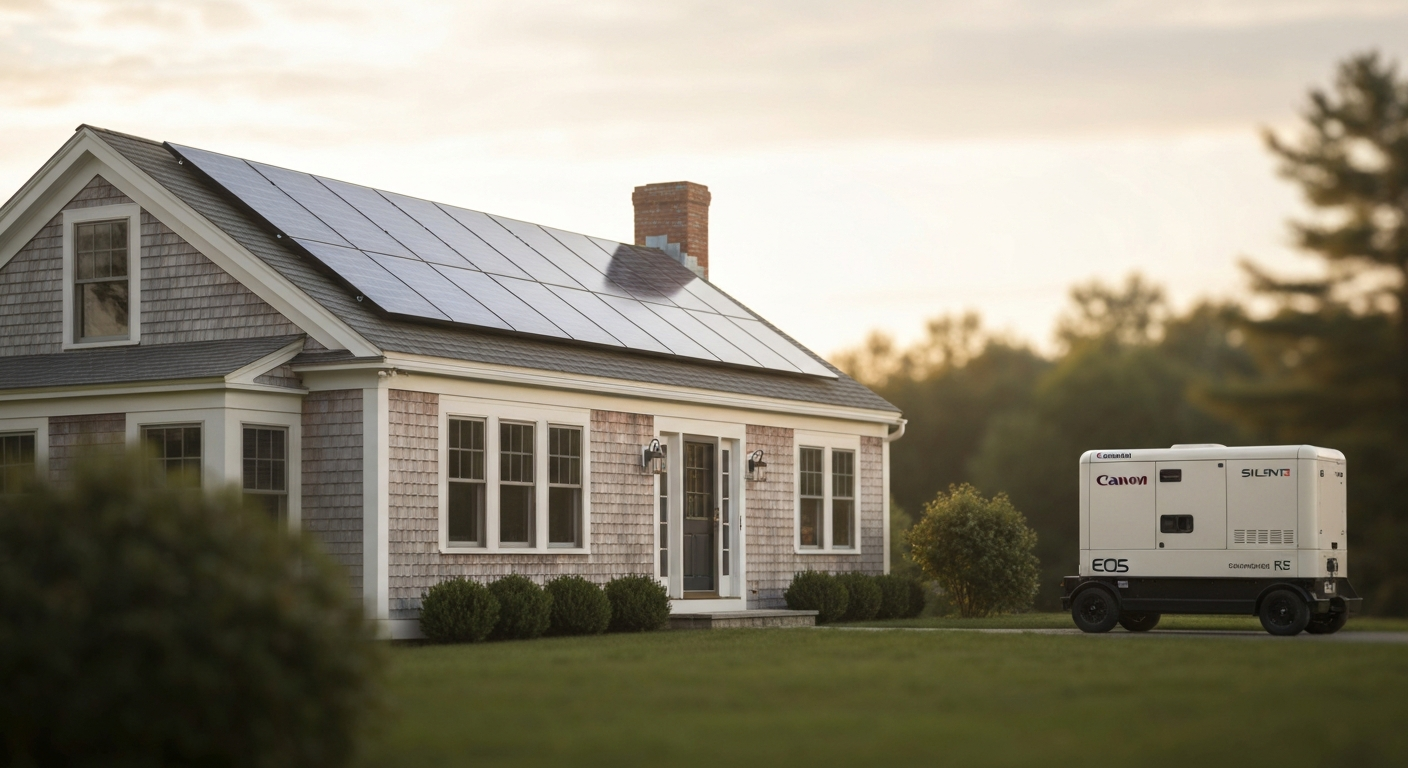
Both keep your lights on when the grid goes down—but they do it very differently. A solar battery is silent, automatic, fuel-free, and recharges from your panels; a generator runs on fuel and can power a big load for as long as you keep feeding it. For most South Shore homeowners dealing with the typical short outage, a battery is the cleaner, more convenient choice and earns money the rest of the year. For long multi-day winter outages with heavy whole-home heating loads, a generator's run-time can still win. Here's the honest comparison.
What a solar battery does well
A home battery like a Tesla Powerwall 3 (13.5 kWh usable, 11.5 kW continuous) or an Enphase IQ Battery kicks in automatically the instant the grid drops—you often won't even notice the flicker. It's silent, has no emissions, needs no fuel deliveries, and pairs with your solar so it can recharge during the day in a longer outage. On top of backup, it earns money year-round through Massachusetts ConnectedSolutions, which a generator never does. The tradeoff is capacity: a battery runs your essentials (and can be sized for more), but it's a finite tank that, without enough solar to recharge, can draw down over a long outage.
What a generator does well
A standby generator running on natural gas or propane can produce a high, continuous output and run for days as long as it has fuel—so for whole-home backup through a long winter storm, it has real staying power. The downsides: it's noisy, it burns fuel and produces emissions, it needs periodic maintenance and fuel supply, and it does absolutely nothing for you on the 360-odd days a year the power is on. Portable generators are cheaper but require manual setup, fuel storage, and safe placement away from the house.
The New England angle: short outages vs. the big one
Most of our outages on the South Shore are hours, not days—and for those, a battery is honestly the nicer experience: instant, quiet, hands-off. The scenario that favors a generator is the rare multi-day outage in deep winter when you're trying to run a lot, including heat. Even then, a battery paired with solar (and sized appropriately) covers a surprising amount, and you can prioritize essential circuits. I help homeowners decide which outages they're actually solving for.
Can you have both? Sometimes that's the answer
For some homes—medical needs, well pumps, frequent long outages—the best setup is a battery for everyday resilience and value plus a generator for worst-case run-time. It's not the cheapest path, but it's the most bulletproof. For most people, though, a properly sized battery does the job. My guide on solar battery backup in New England goes deeper on sizing.
My honest take
If you want quiet, automatic, maintenance-light backup that also pays you the rest of the year, a battery is usually the better fit for South Shore homes—and it's the one I spec and stand behind. If your priority is multi-day whole-home backup on a tight budget, a generator still has a place. I'll tell you honestly which one matches how you actually live, and I won't sell you a battery if it isn't the right call.
Frequently asked questions
Is a solar battery better than a generator for backup power?
For most short, common outages, yes—a battery is silent, automatic, fuel-free, recharges from solar, and earns money through ConnectedSolutions year-round. A generator wins mainly on long multi-day outages with heavy whole-home loads, where its fuel-fed run-time outlasts a battery's stored capacity.
How long will a solar battery power my house during an outage?
It depends on the battery's capacity and what you're running. Sized for essentials, a battery can carry you through a typical outage, and paired with solar it recharges during daylight to extend that. For heavy whole-home loads over several days, you'd want more storage or a generator.
Does a generator save me money like a battery does?
No. A generator only runs during outages and costs fuel and maintenance, with no everyday benefit. A solar battery offsets your usage and can earn money year-round through Massachusetts ConnectedSolutions, so it works for you even when the power is on.
Can I have both a solar battery and a generator?
Yes, and for some homes—medical needs, well pumps, or frequent long outages—that combination is the most resilient setup: the battery for quiet everyday backup and value, the generator for worst-case run-time. For most homeowners, a correctly sized battery is enough.
Not sure which fits your home? Get a free, no-pressure estimate and I'll help you decide based on your outages, your loads, and your budget.