How Massachusetts Winters Really Affect Your Solar Panels
By Dave Simmer
NABCEP-Trained Solar Professional, Scituate, MA
Yes—solar panels work in winter in Massachusetts. They make less power than they do in June because the days are shorter and the sun sits lower, but they keep producing all season, and a good annual estimate already accounts for our New England winters. The short version: cold doesn't hurt your panels, snow only pauses them while it's actually covering the glass, and the summer surplus you bank carries you through the dark months.
Solar runs on light, not heat
This trips a lot of people up. Panels make electricity from sunlight, not warmth—so a cold, clear January day on the South Shore can be excellent for production. In fact, solar cells are slightly more efficient when they're cold. The REC Alpha Pure-R panels I spec have a temperature coefficient around -0.24% per °C, which is a fancy way of saying they actually perform a touch better in the cold than in summer heat. The thing winter takes away isn't temperature—it's hours of daylight and sun angle.
What snow actually does
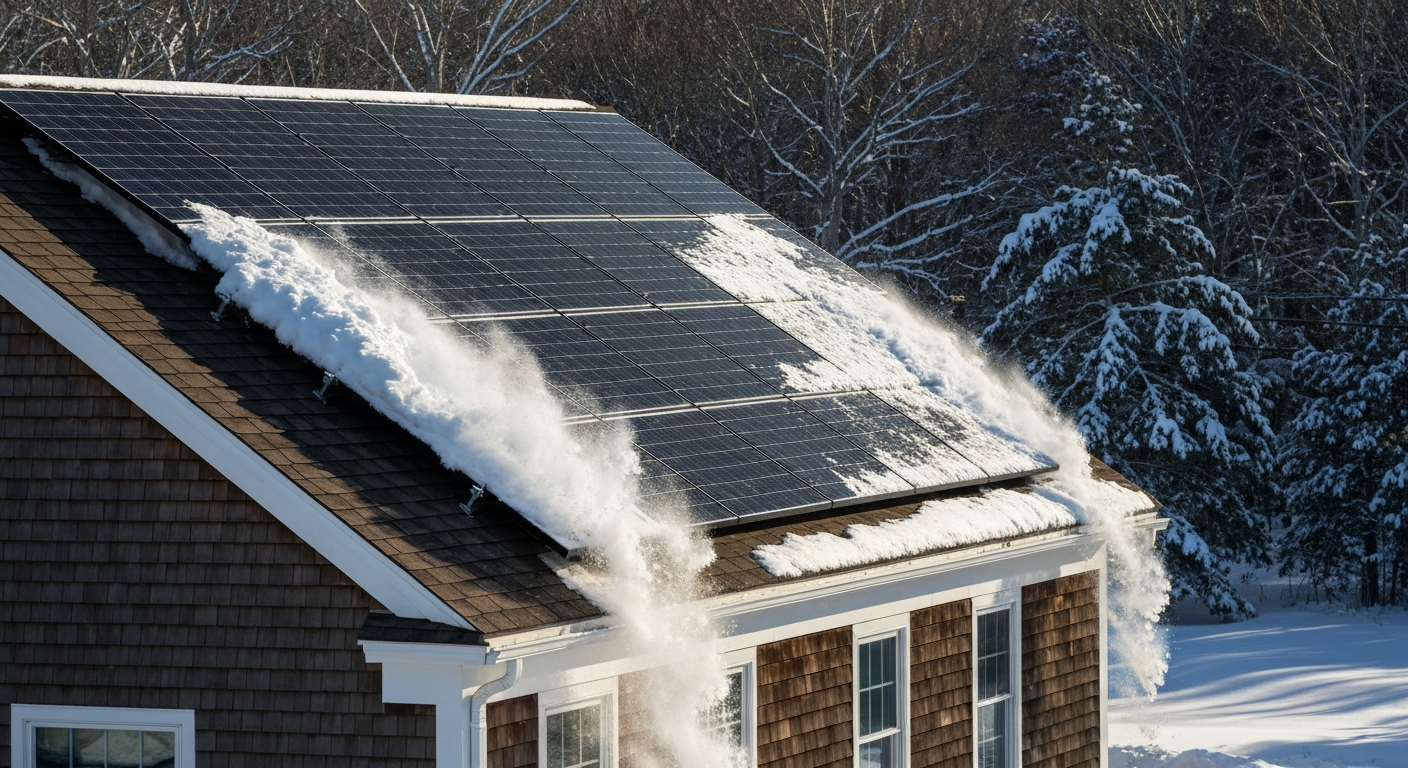
A light dusting barely matters; enough sunlight gets through that the panels keep trickling out power and the snow usually burns off fast. Heavy, wet snow is different—while it's sitting on the glass, that panel is paused. The good news is that panels are smooth tempered glass mounted at an angle, and the dark cells warm up and shed snow faster than your shingles do. Most of the time you'll watch snow slide off a solar array a day or two before the rest of the roof clears.
Should you climb up and clear them off? Please don't
I get this question every winter. My honest answer: leave them alone. The little bit of production you'd recover almost never justifies getting on an icy, sloped roof, and a rake or shovel can scratch the glass or damage the panel. Let the sun and the angle do the work. If you've got a ground-mount or a low, safely reachable section, a soft roof rake from the ground is fine—but never put yourself on the roof for it.
Shorter days and a low winter sun
December is the low point of the year for every solar home in Massachusetts—fewer daylight hours and a sun that never climbs very high. That's normal and expected. The system is sized around your full-year usage, not your December usage, so a slow month doesn't mean the system is underperforming. It means it's January.
How summer pays for winter: net metering
This is the part that makes winter a non-issue financially. From spring through fall your panels usually make more than you use, and in Massachusetts that extra power feeds the grid and banks as credits through net metering in Massachusetts. When winter rolls in and you're pulling more from National Grid or Eversource than you're producing, you spend those banked credits down. You're not trying to break even every single month—you're balancing across the whole year.
Microinverters help when only part of the array is covered
If snow lingers on one corner of the roof, or a low winter sun throws a shadow across a few panels, the way your system is wired matters. With Enphase microinverters (IQ8), each panel produces on its own, so a couple of covered or shaded panels don't drag down the rest of the array. That panel-level production is one reason I lean on Enphase for a lot of New England roofs—you can read more in my Enphase vs. SolarEdge guide, and if trees are part of your picture, my guide on solar with shade from trees goes deeper.
What to expect on your monitoring app
The first winter is when people get nervous, because the production graph drops compared to fall. That's supposed to happen. I'd rather you know what a normal Scituate or Hingham January looks like ahead of time than panic at a low number. I walk every customer through what to watch for after install—here's what happens after you go solar, including how to read your monitoring through the seasons.
The South Shore reality
Out here in Scituate, Hingham, Duxbury and the rest of the coast, we get a real winter—Nor'easters, wet coastal snow, the works—and solar still pencils out for the right homes. The systems I design and oversee are built around our weather, not a sunnier state's. If your roof gets good sun the rest of the year, a few snowy weeks won't change the math.
Frequently asked questions
Do I need to brush snow off my solar panels?
No. Panels are angled tempered glass and the dark cells warm in the sun, so snow slides off on its own—usually faster than it clears off your shingles. The small amount of power you'd recover isn't worth the risk of climbing an icy roof or scratching the glass. Let it melt and shed naturally.
How much less power do solar panels make in a Massachusetts winter?
Winter months produce noticeably less than summer because of shorter days and a low sun angle, with December the low point. That's already built into a proper annual estimate. Across the full year your summer surplus and banked net-metering credits offset the slower winter months.
Do cold temperatures damage solar panels?
No—cold actually helps. Solar cells are slightly more efficient in cold weather, and quality panels like the REC Alpha Pure-R are built and warrantied for New England conditions. What lowers winter output is fewer daylight hours and snow cover, not the cold itself.
Will my winter electric bill go up even with solar?
You may pull more from the grid in deep winter than your panels make that month, but in Massachusetts net metering lets you spend down the credits you banked over the sunnier months. The goal is balancing your bill across the whole year, not every single month.
Curious what your own roof would do across all four seasons? Estimate your year-round savings in about 30 seconds, or get a free, no-pressure estimate and I'll run real numbers for your home.